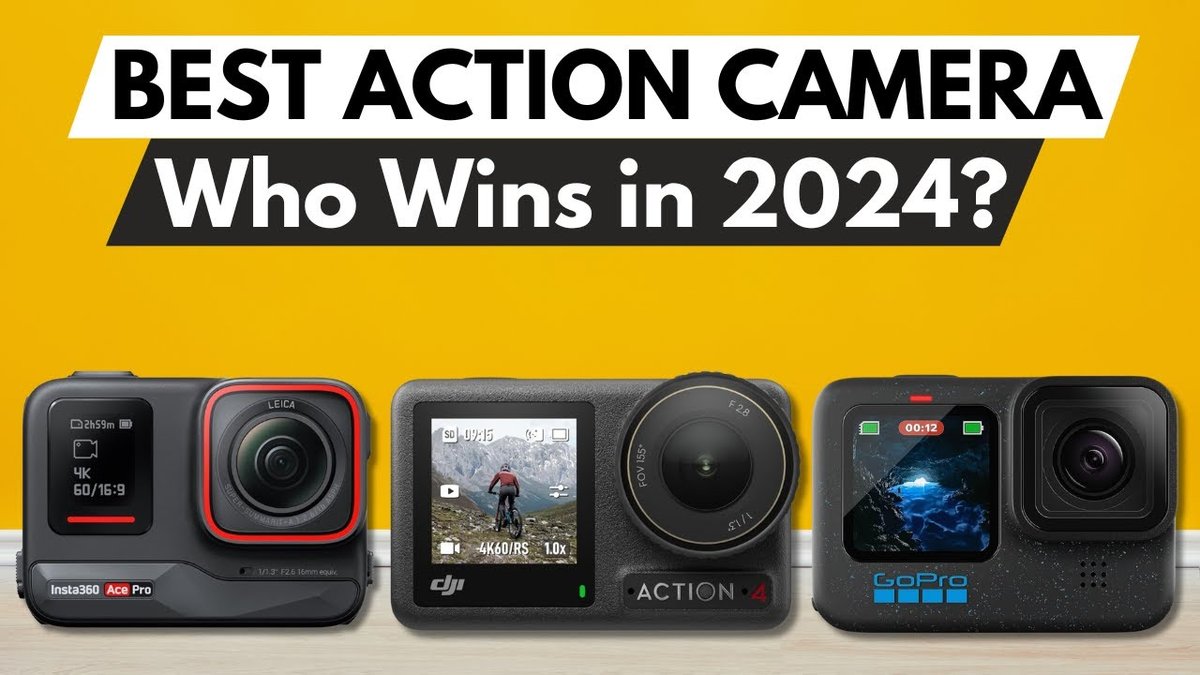
You’ve stood on that cliff edge, plunged into that crystal-clear water, or zipped down that mountain trail, utterly lost in the moment. The thrill is undeniable. But what about the memories? Your smartphone can capture a quick selfie, but it's ill-equipped to truly bottle the raw energy, the sweeping vistas, or the heart-pounding action that defines your adventures. That's where a dedicated action camera steps in – a rugged, compact powerhouse designed to go where no phone dares, bringing home cinematic footage you'll relive for years.
Choosing the right tool from the array of action camera models and comparisons on the market can feel like navigating a jungle. Do you need 8K resolution? Is HyperSmooth 6.0 really that much better? And what about low-light performance underwater? Don't sweat it. We're here to cut through the noise, helping you pinpoint the perfect action camera companion for your next epic journey.
At a Glance: Key Takeaways for Your Action Camera Quest
- Prioritize Purpose: Your primary activity (diving, vlogging, extreme sports) dictates the key features you need most.
- 4K/60fps is the Sweet Spot: For most users, this offers excellent quality and smooth motion without massive file sizes.
- Stabilization is King: Don't compromise here. Look for advanced tech like HyperSmooth or RockSteady for truly usable footage.
- Durability Matters: Check waterproof ratings and shock resistance – your camera needs to survive your adventures.
- Budget for Accessories: Spare batteries, mounts, and protective cases are often essential additions.
- Consider Beyond GoPro: While GoPro is dominant, DJI offers superior low-light, and Insta360 provides unmatched creative flexibility.
Why an Action Camera? Beyond Your Smartphone's Limits
Before we dive into the nitty-gritty of action camera models and comparisons, let's quickly address why these specialized devices exist. Your smartphone takes incredible photos and videos in ideal conditions, but it's fragile, limited in field of view, and simply not built for the abuse of adventure.
Action cameras are designed from the ground up to be:
- Indestructible: Waterproof, shockproof, and ready for extreme temperatures.
- Compact & Mountable: Tiny form factors that can be attached to helmets, bikes, chests, surfboards, or just about anywhere.
- Ultra-Wide: Capturing expansive scenes that convey scale and immersion.
- Hands-Free: With voice control and remote apps, you can stay focused on the action.
- Stabilized: Engineered to deliver smooth footage even during the most turbulent activities.
It's about capturing moments that would otherwise be impossible, or at least highly risky, with conventional gear.
Decoding the Specs: What Truly Matters in an Action Camera
Navigating technical specifications can be overwhelming, but understanding these core metrics is crucial for making an informed decision. Think of them as the DNA of your future action camera.
Image Quality: Resolution, Frame Rates, and Color Fidelity
This is often the first thing people look at. But it's not just about the biggest number.
- Resolution: Measured in pixels (e.g., 4K, 5.3K, 8K). Higher resolution means more detail and clarity. While 8K might sound impressive, 4K is often the sweet spot for most users, balancing stunning visuals with manageable file sizes and battery consumption. If you're not a professional filmmaker needing to crop extensively, 8K might be overkill.
- Frame Rates (fps): How many individual images your camera captures per second (e.g., 30fps, 60fps, 120fps, 240fps).
- 30fps: Standard for cinematic look, good for general video.
- 60fps: Smoother motion, ideal for fast action.
- 120fps/240fps: Essential for truly epic slow-motion effects, where every detail of a jump or a splash is captured with stunning fluidity.
- The Sweet Spot: Many adventurers find 4K at 60fps or 120fps to be the perfect blend of high resolution and buttery-smooth motion.
- Color Accuracy: A good action camera delivers true-to-life colors, making your footage vibrant and authentic without extensive post-editing. Some cameras also offer flat color profiles for those who prefer to color-grade their footage professionally.
Durability: Built to Withstand Your Wildest Dreams
An action camera isn't just for looking good; it's for taking a beating.
- Waterproof Rating: This is non-negotiable for water sports. Look for a specified depth (e.g., 10m, 16m, 30m, 132 feet) without an additional case. An IPX8 rating means it can handle continuous submersion. If you plan deep dives, a dedicated dive housing will be necessary.
- Shock Resistance: The ability to survive drops and impacts. Many cameras can withstand drops from 1 to 1.5 meters onto hard surfaces. This is critical for activities like mountain biking or climbing.
- Temperature Resistance: Your camera should perform reliably in cold snow environments (e.g., -10°C) or hot desert conditions (e.g., 40°C). Cold can severely impact battery life, so look for cameras with improved cold-weather batteries.
- Dust & Sand Resistance: Protected casings (like an IP6X rating) prevent fine particles from ruining your device during beach days or dusty trail rides.
- Anti-fogging Capabilities: Features or coatings that prevent the lens from fogging up during rapid temperature changes, ensuring your footage remains clear.
Image Stabilization: The Magic Wand for Smooth Footage
This is arguably the most important feature for an action camera. Without it, even the most thrilling footage can be unwatchable due to shake.
- Electronic Image Stabilization (EIS): Software-based, it analyzes motion and crops the edges of your footage to smooth out jitters. It's effective but can sometimes slightly reduce overall image quality or field of view.
- Optical Image Stabilization (OIS): Hardware-based, OIS uses gyroscopic sensors to physically shift lens elements or the image sensor itself, counteracting camera movement. This is typically more effective and preserves image quality better than EIS alone. OIS can reduce blur by about 50%, while sensor shift can achieve up to 80% improvement.
- Hybrid Stabilization: The best systems combine both OIS and EIS, delivering incredibly smooth footage with sharper images, sometimes improving stability by up to 70%.
- Specific Technologies: Leading brands have their own advanced stabilization.
- GoPro's HyperSmooth (e.g., 6.0): Widely considered best-in-class, it excels even in low light and extreme conditions, often including Horizon Lock to keep your horizon level no matter how much you spin.
- DJI's RockSteady (e.g., 3.0): A strong rival, it's known for handling rapid directional changes effectively. DJI's Osmo Action 5 Pro also features HorizonSteady.
- Insta360's FlowState: Achieves remarkably stable footage, even over rough terrain, making shaky cam a thing of the past.
Battery Life: Powering Your Adventures
Nothing kills the vibe faster than a dead battery.
- Typical Duration: Most action cameras offer 60-120 minutes of continuous recording. Some newer models, or those with more efficient batteries, can stretch to 160 minutes or even 4 hours under optimal conditions.
- Factors Affecting Life: Recording at higher resolutions (e.g., 4K/120fps), using Wi-Fi, GPS, or shooting in cold temperatures will significantly drain your battery faster.
- Battery Type: Lithium-ion batteries are standard, offering good energy density. Look for cameras that support improved cold-weather batteries, like GoPro's Enduro.
Connectivity & User Experience: Seamless Sharing and Control
- Mounting Options: The versatility of attachments. Standard mounts for helmets, bikes, chest harnesses, and tripods are essential. A rich ecosystem of first-party and third-party accessories is a huge plus.
- Connectivity: Wi-Fi and Bluetooth are standard, allowing wireless content transfer to your phone and remote control via dedicated apps. This is incredibly convenient for setting up shots or reviewing footage on the go.
- User Interface: How easy is it to navigate menus, change settings, and review footage? Touchscreens greatly enhance usability, and some cameras offer intuitive button controls for use with gloves or underwater.
- Additional Features:
- Voice Control: Hands-free operation is a game-changer when your hands are busy.
- Live Streaming: For sharing your adventures in real-time.
- Dual Screens: Front and rear displays are a huge advantage for vlogging, selfies, and precise framing.
- GPS: Adds data overlays (speed, altitude, path) to your videos.
- Modular Designs: Like the Insta360 ONE RS, these allow you to swap lenses (e.g., 4K wide-angle, 360-degree) for incredible versatility.
Head-to-Head: Top Action Camera Models & Comparisons
Now that we understand the key metrics, let's explore the leading contenders in the action camera arena, comparing their strengths and ideal use cases.
1. GoPro Hero12 Black: The All-Around Champion
GoPro remains the industry benchmark, and the Hero12 Black continues that legacy with refinement rather than revolution. It's a powerhouse for anyone seeking top-tier stabilization, robust build quality, and a user-friendly experience.
- Video Prowess: Delivers stunning 5.3K at 60fps and 4K at 120fps, perfect for crisp, detailed footage and cinematic slow-motion. While it can technically shoot 8K/30fps, many find it an unnecessary drain on battery and storage for most uses.
- Stabilization Legend: Its HyperSmooth 6.0 is arguably the best in the business, making even the bumpiest rides look incredibly smooth. Horizon Lock is a standout feature, keeping your footage perfectly level even if the camera spins 360 degrees. It also excels in low-light stabilization.
- Battery Boost: The new Enduro battery significantly extends recording times, particularly performing 2x better in cold weather, a huge plus for winter sports enthusiasts.
- Low-Light Performance: The 1/1.9” sensor, while not the absolute largest, still captures stunning low-light footage, improving on previous generations.
- User Experience: Known for its intuitive touchscreen interface and reliable voice control, making it easy to operate even in challenging situations.
- Durability: Waterproof up to 10 meters (33 feet) without a case.
- Price: Around $399 (without accessories).
Best For: All-around adventurers, professional content creators, vloggers, and anyone who demands best-in-class stabilization and reliability in a familiar, robust package.
2. DJI Osmo Action 4 (and similar Action 5 Pro): The Low-Light & Water Specialist
DJI has been a formidable challenger to GoPro, and the Osmo Action 4 (and the even more advanced Action 5 Pro) shines with its exceptional low-light capabilities and intelligent design, particularly for water-based activities.
- Large Sensor Advantage: Boasts a larger 1/1.3” sensor, which gathers an impressive 2.4x more light than many competitors. This makes it a superior choice for dawn hikes, night skiing, or capturing vibrant details underwater.
- Dual OLED Touchscreens: A game-changer for framing. Having responsive OLED touchscreens on both the front and rear makes vlogging, selfies, and precise shot composition incredibly easy.
- Video Quality: Maxes out at 4K/120fps, delivering beautiful, detailed footage.
- Stabilization: RockSteady 3.0 effectively rivals GoPro's HyperSmooth, competently handling rapid directional changes. The Action 5 Pro adds HorizonSteady for enhanced horizon leveling.
- Extended Battery Life: Offers good battery performance, up to 90 minutes for the Action 4 and an impressive 160 minutes for the Action 5 Pro.
- Deep Waterproofing: Waterproof up to 16 meters (52 feet) without an additional case, giving it an edge over GoPro for serious underwater exploration.
- Underwater Magic: Its Color Boost mode specifically enhances vibrant hues when filming underwater, reducing the need for extensive post-production color correction.
- Connectivity: Features Wi-Fi and USB-C for fast transfer and charging.
Best For: Night adventures, underwater filming, content creators, and vloggers who value superior low-light performance and dual screens for easy framing.
3. Insta360 X3 (and similar ONE RS): The Creative Powerhouse
Insta360 isn't just an action camera; it's a creative tool that redefines how you capture and frame your adventures. The X3 is a 360-degree camera, while the ONE RS offers a unique modular design.
- 360-Degree "Shoot First, Frame Later": The X3 captures everything around you in 5.7K 360° video. This means you never miss a shot – you can reframe and choose your perfect angle in post-production. It's like having multiple cameras recording at once.
- Modular Versatility (ONE RS): The Insta360 ONE RS takes modularity to a new level. You can swap out lenses on the fly, switching between a 4K wide-angle lens and a 360-degree lens, making it incredibly adaptable to different shooting scenarios. Dive into 6 big hero 2 and explore how modular designs are revolutionizing portable cameras.
- Exceptional Stabilization: FlowState Stabilization achieves zero shake, even over the roughest terrain, making your 360-degree footage incredibly smooth and watchable.
- "Invisible" Selfie Stick: With 360 cameras, selfie sticks magically disappear from your footage, creating impossible-looking third-person perspectives.
- Durability: The X3 is shockproof up to 1 meter.
- Editing Potential: Insta360's AI Reframe tool can automatically follow subjects in your 360-degree footage, saving immense editing time.
- Considerations: 360° files are notoriously large (10 minutes of 5.7K footage can be around 10GB) and require powerful computers for editing. The cameras can also be bulkier than traditional action cameras.
Best For: Travel vloggers, creative editors, anyone who wants "no regrets" framing, and extreme sports enthusiasts who need ultimate versatility in angles for dynamic shots.
4. Akaso Brave 8 Lite (and similar Brave 8/EK7000/Brave 7 LE): The Budget-Friendly Contender
For those new to action cameras or on a tighter budget, Akaso offers impressive value without completely sacrificing performance. The Brave 8 Lite, Brave 8, and EK7000 are popular choices.
- Affordable Entry: The Brave 8 Lite typically retails around $199, making it a highly accessible option compared to premium models.
- Respectable Video & Photo: The Brave 8 Lite offers 4K/60fps video, and models like the EK7000 and Brave 8 also provide 4K, while the Brave 8 Lite captures 20MP photos with a surprisingly sharp 1/2.3” sensor.
- Dual Screens: The Brave 8 Lite features dual screens for easy framing, similar to the more expensive DJI models. Other Akaso models like the EK7000 may have a 2-inch LCD.
- Solid Waterproofing: Many Akaso models are waterproof up to 10 meters (Brave 8 Lite) or even 30 meters (Jadfezy mentioned in ground truth) without an additional case, making them suitable for casual water activities. Some are rated to 50 feet (Euorosi) or 131 feet (AKASO EK7000) or 132 feet (ODDV).
- Decent Stabilization: While not on par with HyperSmooth or RockSteady, the EIS in Akaso cameras is decent for its price point, but you might notice some wobble on very rough trails.
- Battery Life: Around 70 minutes for the Brave 8 Lite, often bundled with two batteries (e.g., Jadfezy with two 900mAh batteries) to extend shooting time.
Best For: Budget-conscious users, beginners, casual adventurers, or as a secondary camera where top-tier performance isn't the absolute priority.
Choosing Your Adventure Partner: A Practical Decision Guide
With a better understanding of action camera models and comparisons, how do you pick the right one for you? It boils down to matching the camera's strengths with your primary use cases and priorities.
1. Match the Camera to Your Activity
- Extreme Sports (Mountain Biking, Skiing, Surfing): Prioritize best-in-class stabilization (GoPro Hero12 Black with HyperSmooth 6.0 or DJI Osmo Action with RockSteady 3.0). High frame rates (4K/120fps) are crucial for epic slow-motion replays.
- Water Sports (Snorkeling, Diving, Kayaking): Look for robust waterproofing without a case (DJI Osmo Action 4/5 Pro at 16m+), and features like DJI's Color Boost mode. Consider a red filter for deeper dives to correct color loss.
- Vlogging & Travel: Dual screens (DJI Osmo Action 4/5 Pro, Akaso Brave 8 Lite) are incredibly helpful. Insta360 X3 offers unmatched creative freedom for "no regrets" framing and unique angles. Good battery life and an intuitive user interface are also key.
- Casual Adventures & Family Fun: Budget-friendly options like the Akaso Brave series offer solid performance for capturing memories without breaking the bank.
- Creative Filmmaking & Unique Perspectives: Insta360 X3's 360-degree capabilities open up endless possibilities for reframing and dynamic shots. The ONE RS modular system offers unparalleled versatility.
2. Resolution vs. Frame Rate: Find Your Sweet Spot
- For most users, 4K at 60fps or 120fps offers the best balance. You get sharp details, smooth motion, and the ability to slow down footage beautifully, all without the massive file sizes and editing demands of 8K.
- Only go for 8K if you're a professional who needs to crop extensively, wants extreme detail, or plans significant post-stabilization that requires extra pixel real estate. Be prepared for larger files and heavier battery drain.
- Utilize higher frame rates like 1080p at 240fps specifically for those ultra-cinematic slow-motion moments where resolution is less critical than fluidity.
3. Don't Forget the Accessories!
The camera is just the beginning. Budget for these essentials:
- Spare Batteries: A single battery often lasts only 60-120 minutes. Having at least one or two spares is crucial, especially for longer outings or cold weather. GoPro's Enduro batteries are highly recommended for colder climates.
- Mounts: Helmet mounts, chest harnesses, flexible tripods (like Joby GorillaPods), and handlebar mounts are universal necessities. Third-party accessories can often save you 50% or more compared to branded ones, just ensure compatibility.
- Protective Case/Housing: While many cameras are waterproof, a durable case offers extra protection against impacts and can extend waterproofing to greater depths (e.g., 30m+ for diving).
- Memory Cards: High-speed (U3 or V30 rated) microSD cards are essential to handle high-resolution, high-frame-rate video without dropping frames.
- Red Filter (for Underwater): If you're serious about underwater footage, a red filter (sold separately) will correct the natural color loss that occurs in shallow water, bringing back vibrant hues.
4. Test Drive Before You Buy (If Possible)
If you can, rent or borrow a few action camera models for a weekend trip. This "real-world" test will reveal:
- Intuitiveness: How easy is the interface to navigate mid-action?
- Durability for your activities: Does it feel robust enough for your specific brand of adventure?
- Overall user experience: Does it blend seamlessly into your workflow, or does it feel like a hindrance?
Mastering Your Action Camera: Tips & Tricks for Epic Footage
Having the right gear is half the battle; knowing how to use it effectively is the other. Here are a few practical tips to get the most out of your action camera.
Durability Care: Keep Your Camera Ready for Anything
- Rinse After Saltwater/Sand: After any beach or ocean adventure, always rinse your camera thoroughly with fresh water.
- Check Seals: Before every immersion, double-check that all doors and seals are clean and securely closed. A single grain of sand or a stray hair can compromise the waterproof seal.
- Clean the Lens: Use a microfiber cloth to gently clean the lens. Fingerprints and smudges are more noticeable on wide-angle footage.
Underwater Filming: Bringing Colors to Life
- DJI's Color Boost: If you have a DJI Osmo Action 4/5 Pro, engage Color Boost mode. It makes a noticeable difference in restoring vibrant colors underwater.
- Red Filters are Your Friend: For depths beyond a few feet, water absorbs red light, making everything look green or blue. A red filter (which attaches to your lens) corrects this, ensuring your underwater world looks as colorful as it truly is.
- Mind the Depth: Know your camera's bare waterproof rating, and use a dive housing for anything beyond that.
Editing Your Footage: From Raw to Riveting
- Basic Apps: Most brands offer free, basic editing apps (e.g., GoPro Quik, DJI Mimo, Insta360 App). These are great for quick cuts, adding music, and auto-editing features that can assemble a highlight reel in minutes. They are, however, limited in advanced control.
- Advanced Desktop Software:
- GoPro Player (Free): For GoPro users, this allows you to convert and export footage, including using the fantastic Horizon Lock.
- Insta360 Studio (Free): Essential for Insta360 users, this powerful desktop tool allows you to reframe 360-degree footage, adjust perspectives, and apply FlowState stabilization. Its AI Reframe tool can even automatically track subjects, drastically cutting down editing time for complex 360 shots.
- Third-Party Editors: For serious editing, you'll eventually graduate to software like DaVinci Resolve (free professional editor), Adobe Premiere Pro, or Final Cut Pro.
Your Next Steps to Capture Epic Moments
You've explored the landscape of action camera models and comparisons, understanding the critical metrics and the unique strengths of the leading contenders. The key now is to move from knowledge to action.
- Define Your Primary Use: What kind of adventures will your camera face most often? This will dictate whether stabilization, waterproofing, low-light performance, or creative flexibility is your absolute priority.
- Set Your Budget: Factor in the camera itself, plus essential accessories like spare batteries and mounts. Remember, a cheaper camera might mean compromising on features you'll later wish you had.
- Research Current Deals: Keep an eye out for bundles or sales, especially during peak seasons.
- Start Small, Dream Big: Even a budget-friendly Akaso can open up a world of new photographic opportunities. As you grow, your needs might evolve, but the core joy of capturing those moments will always remain.
Don't let analysis paralysis hold you back. Pick the action camera that best aligns with your adventurous spirit, and get out there. The world is waiting to be captured through your lens.